In the nineties, there was a major breakthrough on the maths scene. It was found that, besides the classical mathematical approach, there was also something like chaotic behavior in systems. Moreover, it was discovered that these systems, although chaotic, obeyed some basic laws.
As an engineer, I always learned at university that chaotic was bad. Uncontrollable. (Engineers are a kind of control freaks, in the end) Never go there, it damages your systems.
But
What if you need oscillations?
What if the wind blows against your bridge or building in the most unpredictable way?
What if a process uses it's data from the outcome of the previous process, and it then starts all over, just with a minor shift in amplitude?
I followed some courses about this. It was high-level mathematics, I'm not going to start the morning with formula's, but you can find more
here (Thanks Wikipedia. You are my source of inspiration!)
Turns out chaos is everywhere (not just our minds. LOL):
Mathematics: recursivity generates chaos, deterministic chaos. Topology uses fractal dimensions (not 2D or 3D, but 2.5D for instance)
Economics: markets fluctuate in an unpredictable way, depending on the index values of the day before, and influenced by hundreds of parameters straight out of the real world.
 |
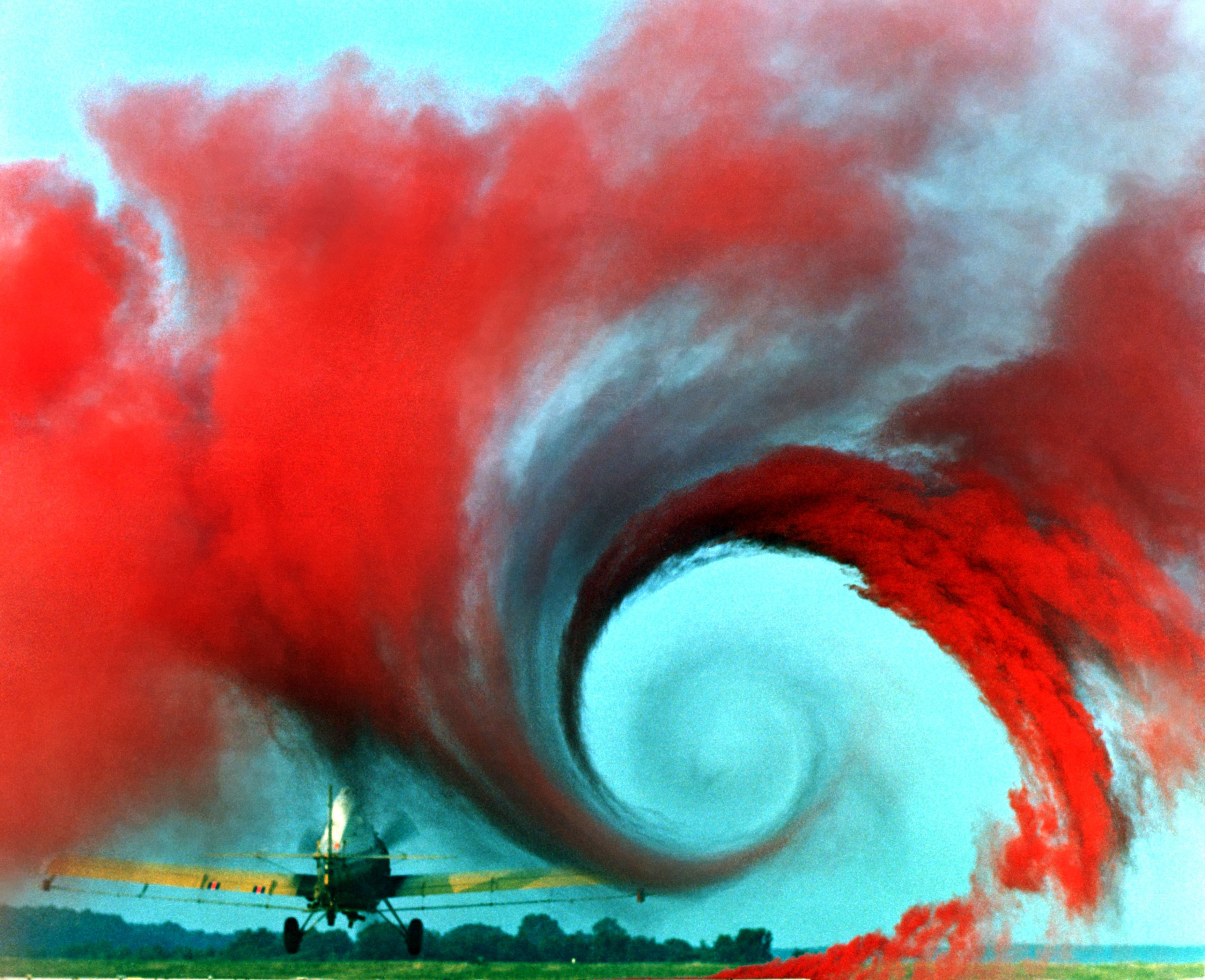
| This vortex. Describe it mathematically. LOL |
Programming: programmers will acknowledge the problem with e.g. generating randomness, recursivity and mimicking real-world behavior.
Biology: the population dynamics (the amount of members onn the next generation) is a typical example.
Meteorology Predicting the weather is only accurate for the next 4 to 6 days. Why? Because it's chaotic. The certainty margin diminishes rapidly after 6 days. Also, predictions of trajectories of hurricanes, long-term forecasting....
Engineering (my thing): unstable systems, predictions of behavior that is non-stable but also not a regular oscillation. (eg. a bridge can oscillate in a regular way. That's fine, because its perfectly simulateable.) An electronic circuit can start oscillating, but there's also a component that is chaotic: e.g. noise in the circuit.
Physics: What happens e.g. on the edge of a fluid freezing to a solid is a chaotic process.
quantum dynamics....( this is a nice one. It links two novel theories to each other!!!! ) The orbits of electrons around the core, the prediction of the position or energy of particles inside an atom,...
 |
| Lorenz strange attractor. |
Also:
politics,
philosophy,
robotics,
magnetic fields,
laser behavior,
neural behavior (medicine)
ecology,
relativity theory,
...
So I still have a lot to write about. But anyway, those with a technical-academic mind reading this, did you ever learn anything about this at school?
Because this is 21th century stuff. Fundamentals of contemporary science.